Chapter 2: Introduction to venture capital and private equity markets
It is important to start by looking at unlisted companies, and the venture market. Here it is key to consider the so called “capital gap”, which refers to unlisted firms’ barriers to capital. This arises due to the confluence of information asymmetry, agency conflicts and moral hazard. This chapter also introduces VC and PE funds, VC and PE activity, how they invest, and where they obtain their money.
2.1 Unlisted companies and the problem of capital
Unlisted companies face significant barriers to raising capital. In general, companies can raise capital from two main sources: debt and equity. Neither are readily available for many early stage companies. Some of these problems can persist even for large, albeit risky, companies.
Debt is often difficult or costly to obtain for early stage companies. Lenders’ returns are limited by the interest they charge. But, lenders lose if the company defaults. Early stage companies are often not profitable. Their financials are often not audited. There is often little information available about the company, with the company’s success being premised on future growth. Therefore, it is difficult for a lender to evaluate the company’s quality due to this information asymmetry. Thus, lenders often will not lend to early stage companies. Alternatively, lenders might impose additional constraints on the debt they provide. These can include forcing additional collateral requirements, including requiring owners to guarantee the company’s debt. Lenders might also charge higher interest rates. This is also the case for listed companies that might approach bankruptcy (Tham, 2021).
Ordinary “retail” investors are often unlikely to invest in early stage start ups. This is because of rational risk-related reasons and regulatory reasons. Early stage companies are often difficult to evaluate. As indicated, startups’ financial statements are often opaque, poorly constructed, and not audited. Investment decisions are based on future growth projections. Usually, these require some investment experience and expertise about (inter alia) the company’s market, management team, and financial projections. They also require financial experience about how to value such opaque companies. Thus, retail investors are unlikely to invest. Further, regulators often limit such investments in order to prevent investors being misled by unethical companies.1
Listed companies might also face issues. These issues can overlap with those of early stage unlisted companies. Some listed firms face financial difficulties, and might benefit from a new management team and from expertise. This might be because the current management team has been underperforming. It might be that the firm, despite being listed, has faced difficulties attracting capital. It might be that the costs and restrictions associated with being listed make it optimal for the company to delist, raise capital, and generate growth. In all cases, there can be a role for investors that might have the resources and expertise to acquire the listed firm, take it private, and restructure it. This is where private equity (PE) and leverage buy out (LBO) investors can become involved.
2.2 How then might companies raise capital
The issue is then how companies might raise money when they otherwise have poor access to capital. They have several options. These include equity crowd funding, angel investors, venture capital funds, and private equity funds.
2.2.1 Equity crowd funding
Equity crowd funding is an increasingly prominent method for raising funding. However, it often attracts quasi-retail investors. The company will first approach a crowd funding platform (i.e., Birchal, VentureCrowd, etc). Next, if the platform approves the company, the platform then hosts the company. The platform will collect payments on the company’s behalf and facilitate the transfer of money to the company and the transfer of equity to the investor. The platform will often also advertise the deal, usually to a retail investor audience. Crowdfunding has become increasingly prominent, with several relatively large deals (see e.g., Figure 1).
Several factors are relevant here and these factors often lead towards quasi-retail investors investing. These factors also suggest that the returns to equity crowdfunding might not reflect the risk that investors assume.
First, in equity crowd funding, the company sets its valuation and there is typically no negotiation around the valuation. This can lead to companies setting “optimistic” valuations, which well exceed what a sophisticated investor would pay. This initially looks attractive to the company: for a given amount of money, they give away less equity. But, it ultimately hamstrings the company’s growth. Future capital raises must implicitly be at a higher valuation. But, if they already made an optimistic valuation, it will be difficult to convince a sophisticated investor later to pay a higher valuation for the company.
Second, equity crowd funding tends to skew towards “trendy” companies and/or companies with many customers (these need not be big ticket customers). This is because crowd funding is partly an advertising exercise. Thus, it is not all apt to all companies, especially those that perform complex or boring functions. Arguably, part of the “return” that investors receive in equity crowd funding is non-pecuniary (Zein, 2014). Thus, equity crowd funding might generate worse financial returns than other asset classes.
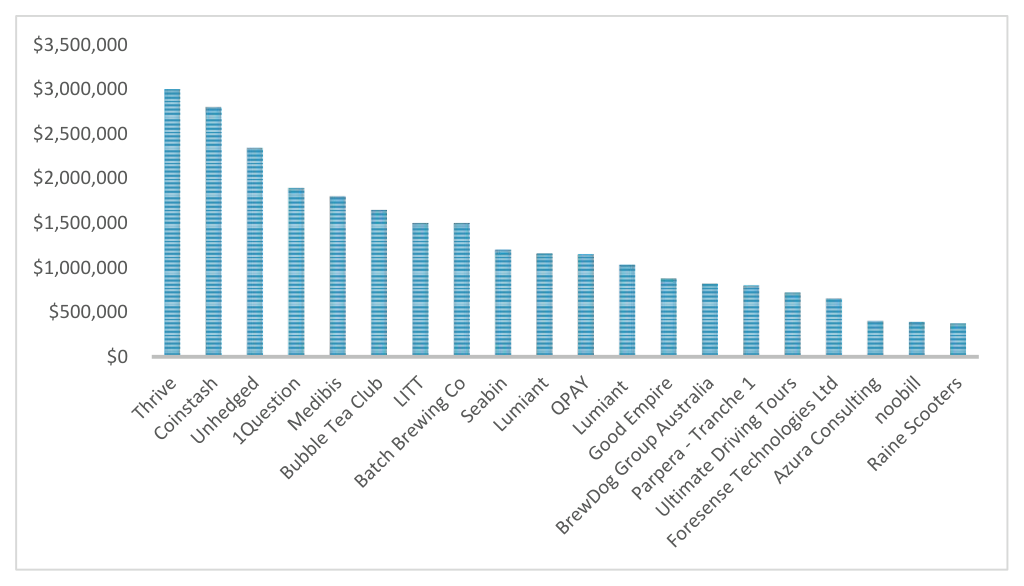
Figure 1: Crowdfunding deals in 2021 in Australia.
This figure contains a selection of large equity crowdfunding in Australia in 2021. The data is from Business News Australia / Dedovic (2021).
2.2.2 Accelerators
Accelerators have become increasingly prominent. Accelerators aim to provide extremely early stage support to startups. Oft-times an accelerator invests pre-seed. The investment could precede the firm having a prototype. Thus, the accelerator might become involved before Angel Investors, VC funds, or equity crowd funding are appropriate. Accelerators can be private organizations (see e.g., Antler) or affiliated with universities (see e.g., UNSW Founders). University affiliated accelerators usually focus on companies within the university’s network, including students, faculty, and alumni.
What might an accelerator do?
What then does an accelerator do and how do founders approach one? The usual process is that a founder applies to an accelerator. Some accelerators are selective or have specific criteria. Precisely what the accelerator does depends on the accelerator and the stage of the company: the appropriate help for a pre-prototype company might differ from that for a mature one with a solid founding team that is ready to go to market
An accelerator can contribute in several ways:
-
An accelerator is more likely to invest earlier than other investors. Thus, they can provide initial capital to a high risk company that might otherwise face significant barriers to finance.
-
Some accelerators purport to help founders find co-founders with additional technical or management skills. This can help accelerate the development journey.
-
Accelerators’ personnel typically have significant experience commercializing companies. Thus, they can place the firm in a better position to obtain follow on rounds. This might arise by guiding the company about business management practices, accounting requirements, corporate governance requirements, and how to approach investors for additional capital. Accelerators can also help companies solve common business problems. In so doing, they can hasten corporate development.
-
Accelerators may, but need not, provide ‘follow on’ funding to startups (Antler, 2021). Here, at future raises, the accelerator might contribute to additional funding rounds for the startup.
Disadvantages of accelerators
There can be some disadvantages of accelerators both for founders and for subsequent investors. Not all accelerators have these disadvantages, or the disadvantages might apply to different extents. For example, university accelerators often have fewer disadvantages as they exist, in part, to assist the university’s students, staff, and alumni.
The main disadvantage for founders is dilution. Companies typically approach accelerators relatively early. Thus, accelerators invest in the company at a relatively low valuation. Therefore, the founders are likely to experience non-trivial dilution if they raise money from an accelerator. The offsetting factor is that the accelerator could contribute both money and ‘labor’, potentially justifying the dilution.
The main disadvantage for follow-on investors is high valuations and ‘polish’. Companies that come out of accelerators typically demand high valuations. This is due to the accelerator trying to achieve a strong return both to increase the value of their equity and as marketing to encourage future companies to apply to their accelerator. The company’s fundamentals might not justify those valuations. Accelerators can often be strong-willed negotiators. Thus, investors must be prepared to reject overpriced companies and hold out rather than merely accepting an accelerator’s valuation. Further, follow on investors must be aware that accelerator-backed companies might present in a more ‘polished’ manner. This might make the companies appear stronger than other less polished – but potentially better value – competitors.
2.2.3 Angel investors
Angel investors can be an important source of funding for early stage companies. They usually have more in common with venture capital funds than with crowd funding investors. Angel investors are typically high net worth individuals. Shows such as “Shark Tank” and “Dragon’s Den” have popularized Angel Investing. However, they are unrealistic and are dramatized, often glossing over the thorough process that many Angel Investors employ to choose investments.
Angel Investors typically invest in “seed” round to “Series A” round investments. However, they will typically also invest in follow on rounds in companies that they have already invested in. There is significant heterogeneity in how Angel Investors make decisions. Some do invest in a manner akin to gambling. Commonly, they will perform due diligence similar to that of a Venture Capital fund. This includes evaluating the firm’s finances, sales, technology, and market size. Angel Investors often invest in a syndicate, thereby amplifying their bargaining power (see e.g., Sydney Angels).
Angel Investors often remain involved in their portfolio companies after investing. The nature and extent of involvement will depend on the Angel Investor’s skill set and the investment size. Larger investment groups will often seek representation on, or observance of, the company’s board. They might help to connect the company with customers, suppliers, or other entities. They might also help to facilitate future capital raises.
Angel investors can invest as part of a group, or Syndicate. Different syndicates operate differently and have different processes. An example is Sydney Angels, which is one of Australia’s largest angel investor groups. It started in 2008 and has more than 100 members.2
Sydney Angels has several layers of screening. Investors submit a short proposal to Sydney Angels for consideration. The Investment Committee then creates a ‘long list’ of possible candidates, which then present at a deal screening meeting (DSM). There are five or so such meetings each year. All members can vote at the DSM for a shortlist of three companies. These companies then present at a larger members meeting. Thereafter, interested members form groups that perform due diligence. If the company passes due diligence, it can receive investment.
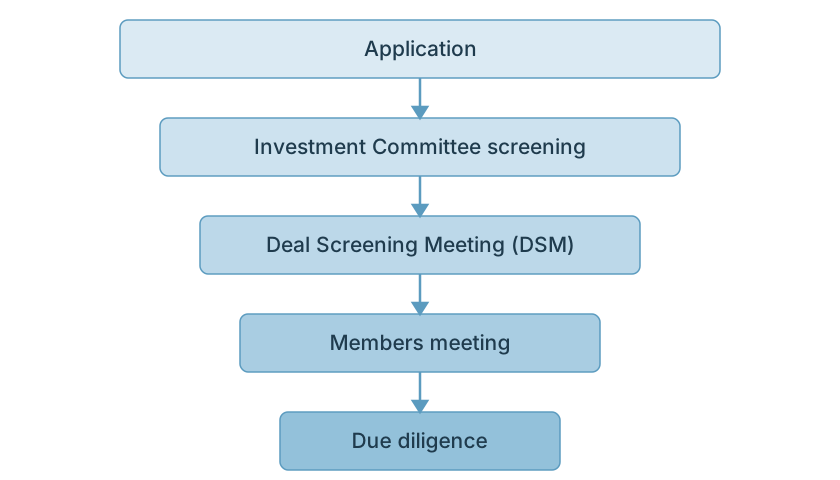
The Sydney Angels screening process. Companies pass through successive layers of screening before receiving investment.
The precise number of companies can change over time. These can change with random fluctuations and with market conditions. For example, covid shifted the number and type of companies in 2020 and 2021. However, there has broadly been an increase in the number of companies seeking capital over time, especially when all angel groups and the growing number of VC funds are considered. Figure 2 illustrates this, detailing the number of companies that have applied to Sydney Angels and the number (and proportion) of companies that pass through each layer of screening.
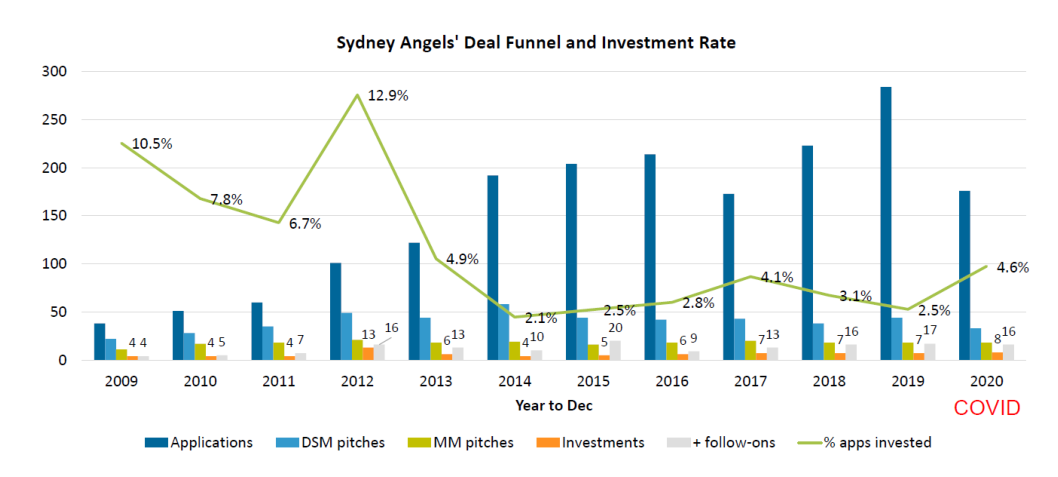
Figure 2: Sydney Angels Screening.
This graph contains details on the number of companies applying to Sydney Angels for funding and the success rates for these companies at each layer of screening. The graph is from Sydney Angels (https://www.sydneyangels.net.au/)
2.2.4 Venture capital
Venture capital (VC) funds typically invest in moderately early stage companies. Most VC funds will invest in a series A round or later. Typically, the way this works is a VC management firm will have multiple different VC funds. These funds might come in sequence (i.e., Fund A, B, C might be raised consecutively in different years) or they might focus on different sectors, or both. VC funds raise their money from investors called “limited partners” (or LPs).
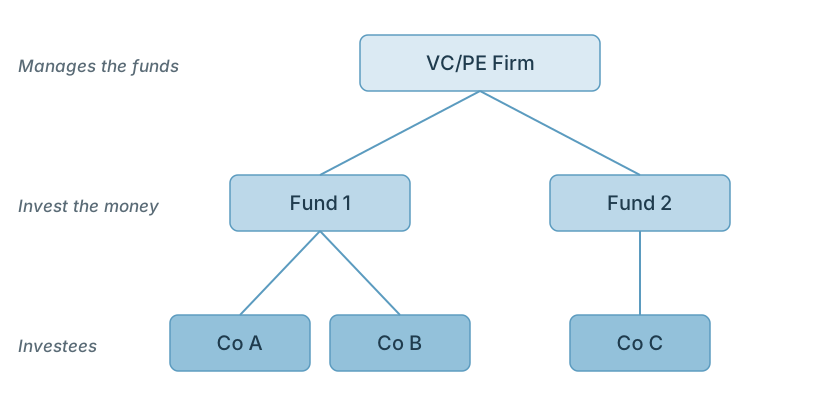
Structure of a VC management firm. The management firm manages the funds; each fund invests the money; the portfolio companies are the investees.
The VC fund typically has a 10 year life-span and organizes its activities accordingly. This is because they must have a time horizon over which to return capital to LPs. Typically, the VC fund will spend the first few years finding investments, the middle years developing their portfolio companies, and the final years exiting (i.e., selling) those portfolio companies. The fund must exit the companies so that it can return capital to investors. Thus, it has a finite life span. Investors can agree to extend the fund’s life span. They might do this if they believe that waiting will improve returns and/or that lucrative investments are imminent. If the VC fund has difficulty exiting companies (i.e., via an IPO or a takeover) the VC fund might seek another VC or PE fund to acquire the company to continue its development.
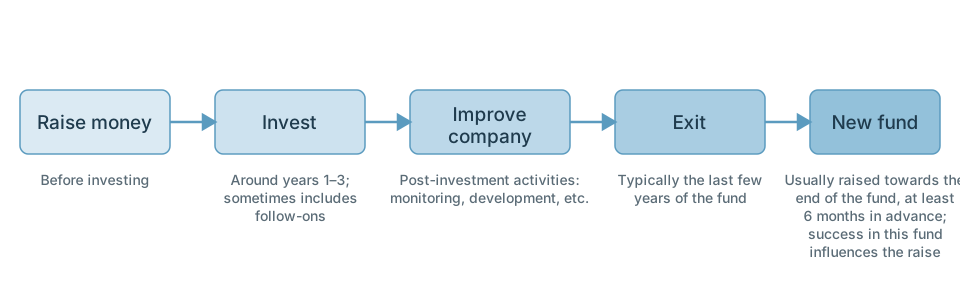
The life cycle of a VC fund. The fund raises money, invests it (mostly in years 1–3, sometimes with follow-ons), improves the portfolio companies, exits them in the fund’s final years, and typically raises a new fund towards the end — with success in this fund influencing the next raise.
VC funds should perform thorough due diligence before investing. Due diligence often involves screening the companies to evaluate their market, traction, financials, team, and valuation (AirTree, 2021; Kaplan and Stromberg, 2004, 2003, 2001). VCs will often set terms in the investment that are designed to mitigate ‘agency conflicts’, which are inherent to any situation where outside investors must rely on agents to perform a task on their behalf (Ang et al., 2000). VC funds will often continue to contribute to the company after investing. The nature of that contribution will depend on several factors, including what is necessary for the company, the VC fund’s expertise, and the size of the investment.
2.2.5 Private equity
Private equity is a broad category. However, we can focus on two main sub-categories.
First, PE funds might perform a similar function to VC funds, but with a focus on larger later stage deals. Here, PE funds will perform much the same function as VC funds. Here, much like with VC funds, the PE fund will screen companies, set terms to mitigate agency conflicts and information asymmetry, and then contribute to the company after investing.
Second, some PE funds undertake leveraged buyout (LBO) transactions. A LBO transaction involves borrowing to acquire the company. Often, PE funds do this with a consortium of other investors. The investors might include the management team, in which case it can also be a management buyout (MBO). LBO-type transactions are typically for listed firms. The main reason is that the company could gain from restructuring. This might be because being listed can be expensive and restrictive. With an LBO transaction, the goal is typically to relist the company after restructuring it.
2.2.6 Leveraged Buyouts (LBOs) and Management Buyouts (MBOs)
Leveraged Buyouts (LBOs) and Management Buyouts (MBOs) are a form of private equity investment. LBOs involve the LBO fund using leverage to acquire the portfolio company. LBO deals can involve a consortium of investors. The debt is usually placed onto the firm’s balance sheet. This increases the firm’s financial leverage. The investors usually aim to ‘reform’ the company and then exit it. The intended changes will depend on the company’s situation. They can involve expansion plans, management changes, operational improvements, and divestitures. Management Buyouts are where managers work with the LBO fund to acquire the company. LBOs and MBOs often, but need not, involve acquiring a listed company, taking it private, and then relisting it after increasing the company’s value.
LBO activity has increased over time. Figure 3 plots buyout data over time. This data is from Preqin and only includes deals denominated in USD, are in the Preqin universe, and are classified as completed buyout deals. However, LBO activity is sensitive to market conditions. For example, Covid significantly negatively impacted the amount of LBO activity. By contrast, before 2020, total LBO deal numbers and values had increased over time.
LBO deals have been controversial. For example, there are concerns that LBO deals involve excessive debt, thereby putting companies at risk. Politicians, such as Elizabeth Warren, have asserted as much. They have proposed policies to restrict LBO debt, post-investment dividends, and LBO activities (Franck, 2021). However, these concerns are often based on faulty assumptions. For example, academic evidence indicates that LBO funds do not over-lever their firms. This is in part due to the companies being under-levered before the deal, post-deal operational improvements increasing the optimal amount of debt, and implicit support from LBO investors for this debt should the company run into financial trouble (Haque, 2020).
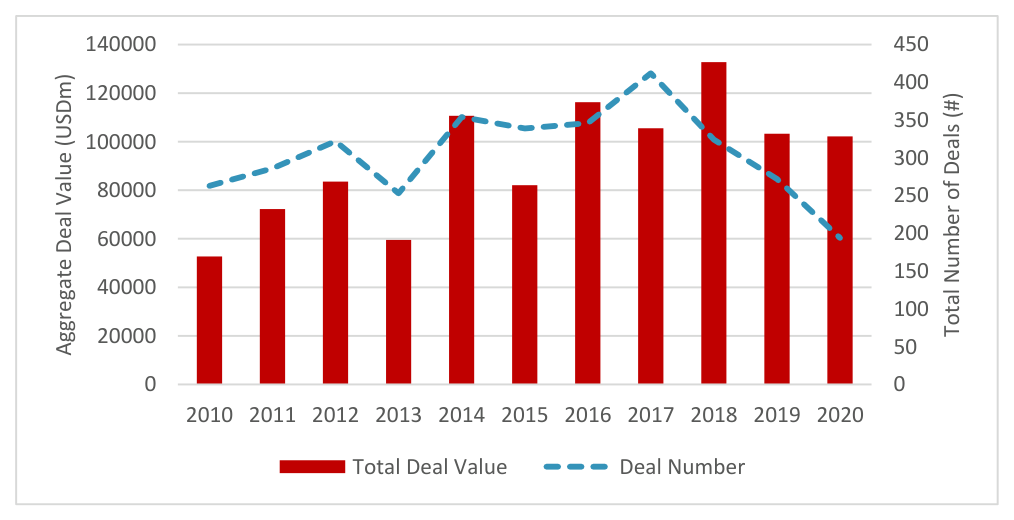
Figure 3: Buyout Deals Over Time: Aggregate Activity.
This figure contains buyout activity over time both in terms of the total number of deals and total deal value. The data only includes deals in USD and that are classified as “buyout” deals. These are the numbers recorded in Preqin.
2.3 Venture capital and private equity activity
Venture capital and private equity have generally increased over time. The below graph indicates how VC/PE activity has changed over time, mostly trending upwards. However, VC and PE activity has fluctuated with economic activity and with regulations. For example, the number and value of funds has reduced in both 2008/2009 and in 2020. In other markets, incentives can encourage VC/PE activity (Humphery-Jenner, 2012a), whereas other interventions (i.e., IPO suspensions) can reduce VC/PE activity.
The amount of money going into the VC/PE sector can also influence funds’ returns. For example, if VC/PE funds have “excess” capital they might suffer from a “money chasing deals” problem (Diller and Kaserer, 2009), whereby VC/PE funds must find deals in which to invest. However, due to the amount of money in the sector, the funds have more money than they have quality investments. This ultimately can hurt returns. “Excess” capital can also contribute to diseconomies of scale in VC/PE (Humphery-Jenner, 2012b; Lopez-de-Silanes et al., 2015). These could reflect the VC/PE funds spreading their limited human capital over more portfolio companies, thereby causing them to exert less discipline when making investments and to be less assiduous in monitoring them.
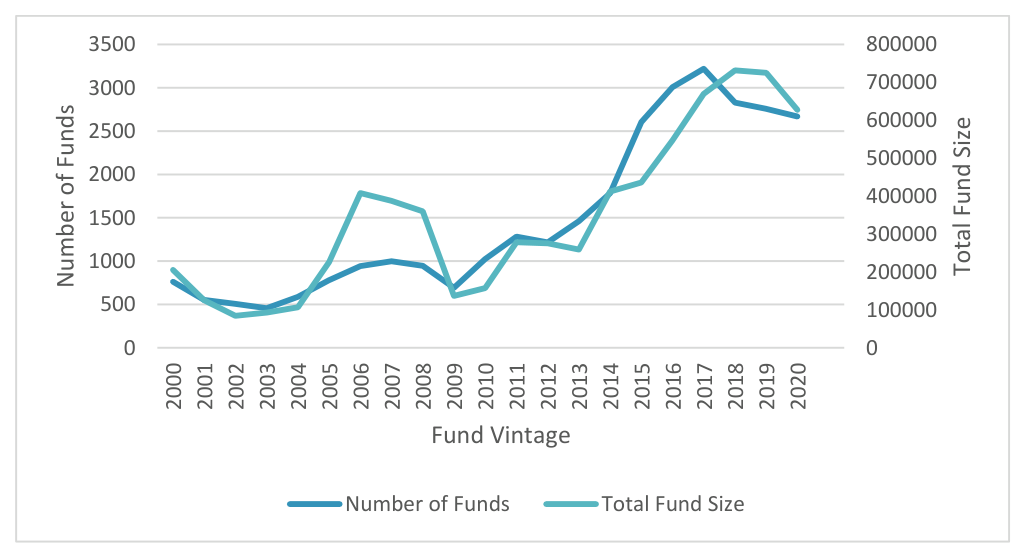
Figure 4: VC/PE activity over time.
This graph illustrates VC and PE activity over time. Data is from Preqin.
2.4 How do VC/PE funds invest: an overview of term sheets
VC and PE funds screen companies to determine which companies to invest in. VC/PE companies then face several issues. These pertain to “agency conflicts” and “information asymmetry”. The term sheet contains contractual terms between the company and the investors that aim to mitigate these agency conflicts.
An agency conflict arises where a principal (i.e., a shareholder) hires an agent (i.e., a manager) to perform a task. Here, the manager might have different goals and incentives from the shareholder. For example, a manager might want to exert less effort than the shareholders would want (Bertrand and Mullainathan, 2003), or might make self-interested investments, or ill-disciplined investments (Masulis et al., 2007), safe in the knowledge that they might be disproportionately rewarded for success but not penalized for failure (Harford and Schonlau, 2013). Relatedly, managers might undertake investments that are designed to further entrench themselves, but do not maximize shareholder wealth (Harford et al., 2012).
Information asymmetry exacerbates these agency conflicts. Information asymmetry arises in a relationship where one party has better information about the situation than does another party. For example, a founder knows more about the company’s prospects and its true state of affairs than do investors. This has arguably been the case in several failed startups, such as Theranos. Information asymmetry can enable founders to mislead investors due to investors’ relative information deficit. Information asymmetry also exists after an investment. This is because it is impossible to completely monitor the founders to ensure they act in the company’s best interests rather than acting ultra vires and in a manner that does not maximize shareholder wealth.
The term sheet aims to mitigate these problems. The term sheet does this by stipulating the terms of the agreement between investors and founders. It will contain information such as when the founders would obtain money, and how much they obtain at what stage; milestones that the founder must reach to secure additional money; whether the founder’s equity “vests” over time; and, the investors information rights. In so doing, the investors aim to protect themselves from unscrupulous, ill-disciplined, or unskilled founders.
2.5 How do VC and PE funds determine how much to pay?
VC and PE funds must also determine what to pay for the companies in which they invest in. This is akin to identifying an appropriate share price for a listed firm. This is important. Paying too much for a company will reduce – or eliminate – returns. It is not the case that VC/PE funds, or angel investors, simply gamble on a team.
Several valuation approaches are available. These warrant deeper discussion and analysis. And, in practice, investors might use a combination of these methods in order to triangulate towards an appropriate valuation. Some options include:
-
Multiples based valuations: Here, the valuation is a function of the firm’s revenue, or another factor deemed to be appropriate. The valuer might use a Price/Sales or Price to Earnings multiple. For example, if a typical value for Price/Sales is 10, then the implied price would be 10 times the firm’s sales. Different multiples and values might apply to different sectors and different types of company.
-
Comparable deals: Valuers often look at comparable deals, in addition to multiples, to determine a valuation. Here, the valuer would look at what deals at this stage had usually been valued at. This would vary between industry and could also depend on other characteristics.
-
Discounted cash flow (DCF) valuation: DCF valuation is a staple valuation technique. It is often difficult-to-impossible to employ for early stage companies. This is because it would require many explicit assumptions about the firm’s growth rate, trajectory, and cost of capital. This approach is usually more appropriate for later stage companies.
-
IRR-based valuations: Here, the investor might arrive at a valuation such that they would achieve a given IRR based on a presumed exit valuation. This is useful in specific situations.
2.6 Where do VC/PE funds get their money?
The discussion so far has focused on the relationship between VC/PE funds and the companies that they invest in. However, VC/PE funds must obtain their money from investors themselves. These investors are called Limited Partners (LPs). LPs provide capital to VC/PE funds in the hope that they will receive a return. The LPs range from high net worth individuals through to fund-of-funds.
The fund’s investment mandate dictates what the fund can invest in. The LPs will set this in conjunction with the VC/PE fund. The mandate might be broad, in which case the VC/PE fund can invest in myriad sectors and company sizes. Or, it might be narrow and focus on particular sectors, sizes, or themes.
The contract will also stipulate the fees that the VC/PE fund can charge for managing the LPs’ money. The fees typically have two components: a management fee and “carry”. The management fee is a percentage charge (typically) over investment capital. The “carry” is the portion of the fund’s investment return that the VC/PE fund managers are entitled to. Specific terms stipulate the details of both the management fee and the carry.
-
This often manifests through disclosure requirements. These requirements are designed to protect investors by ensuring that they receive significant information about investments. But, the requirements are often costly. Companies need not satisfy these requirements if (inter alia) the investors are sophisticated investors (see Corporations Act 2001 (Cth) Section 708). ↩
-
Details about Sydney Angels are available here: https://www.sydneyangels.net.au/ ↩